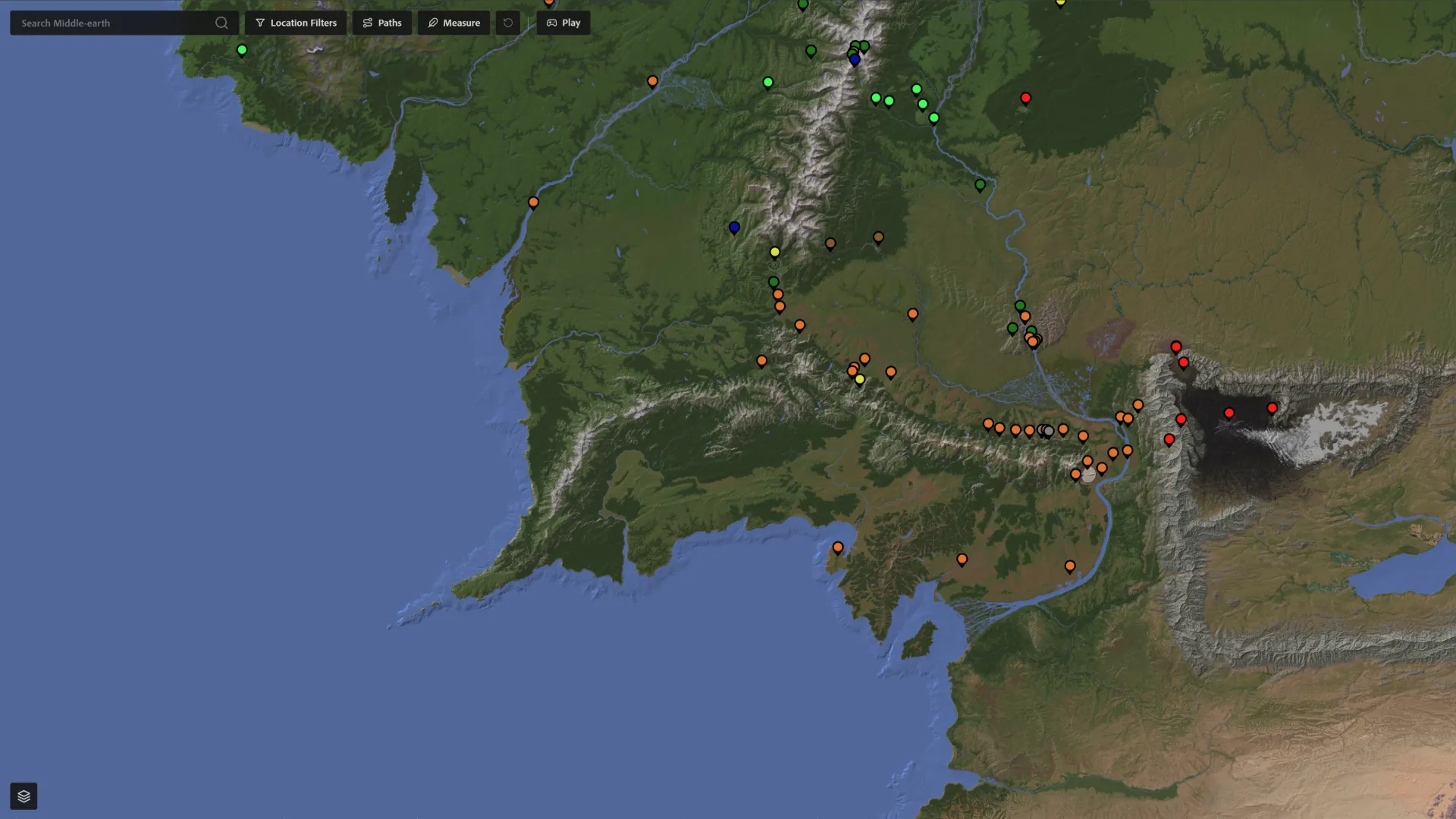
I realised there were over a million searches a year for maps of Middle-earth. To bring that audience to ArdaCraft, I built an interactive map inspired by Google Maps. The goal was to capture 330,000 clicks a year on a query with little competition (a difficulty of 36%). And within a few months the bet paid off: the map brings in half of our new visits!
The opportunity
In my constant search for new opportunities to grow ArdaCraft, I decided to take our SEO strategy seriously. While analyzing the market around Tolkien's universe, one specific segment immediately caught my attention: map searches. The Semrush data showed an ecosystem of more than one million searches per year when including every variant of the keyword "middle earth map".
Digging into the numbers, I discovered an incredible traffic opportunity: the potential amounted to more than 330,000 clicks per year up for grabs in the first position. Yet Semrush's difficulty indicator (the Keyword Difficulty) remained very accessible, with a score of just 36% (labeled "Possible" by the tool). A quick SERP analysis confirmed my intuition: the top three results were all interactive maps, proof that Google expects a dynamic tool to satisfy users.
That's when the connection with ArdaCraft became obvious. We had assets the other maps did not. Precise geographic data (biomes, regions, coordinates from our Minecraft map), thousands of unique photos to concretely illustrate each location, and above all a community of enthusiasts who know Tolkien's texts inside out to guarantee absolute accuracy.
To offer that superior experience, I decided to launch our own interactive map of Middle-earth. Here's how we turned that search data and our community strengths into a concrete project, designed from day one to rank on those queries.
SERP analysis
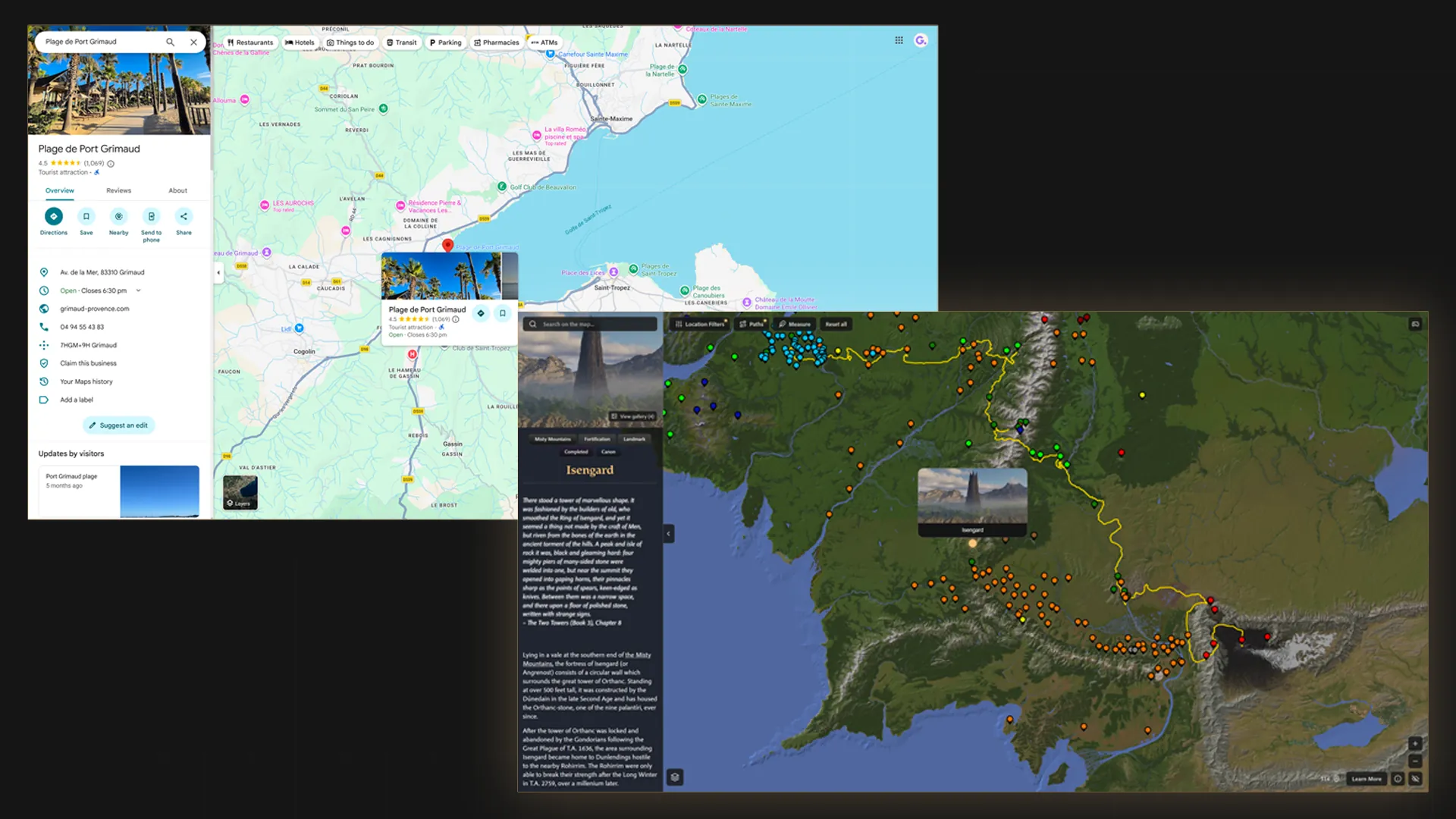
To surpass the established players, duplicating what they did wasn't enough. I spent time dissecting the maps in Google's Top 3. My conclusion was simple: they were generally good, but they all suffered from major compromises. Most were nearly unusable on mobile, and each had one interesting feature the others lacked. The information and the experience were fragmented.
My product strategy was therefore to gather in one tool the features scattered across the others, and add ours. For the interface (UI) and usability (UX), I chose not to reinvent the wheel. I based everything on the universal standards of Google Maps, a tool everyone already knows how to use, to offer immediately smooth and intuitive navigation.
The V1 launch
Building this map happened in several stages. V1 first served as a proof of concept. Its goal was simple: prove the tool's value to our community and validate our assumptions. On this first version, the main challenges centered on features and access to quality data.
The major difficulty lay in collecting and placing that data: tracing the precise path of Frodo's journey, for example, requires someone to manually enter several thousand distinct geographic coordinates. Beyond this titanic work, we had to build an interface capable of displaying this mass of information without saturating the screen or losing the user, all while handling heavy bug fixing as the code grew more complex.
V2, mobile and gamification
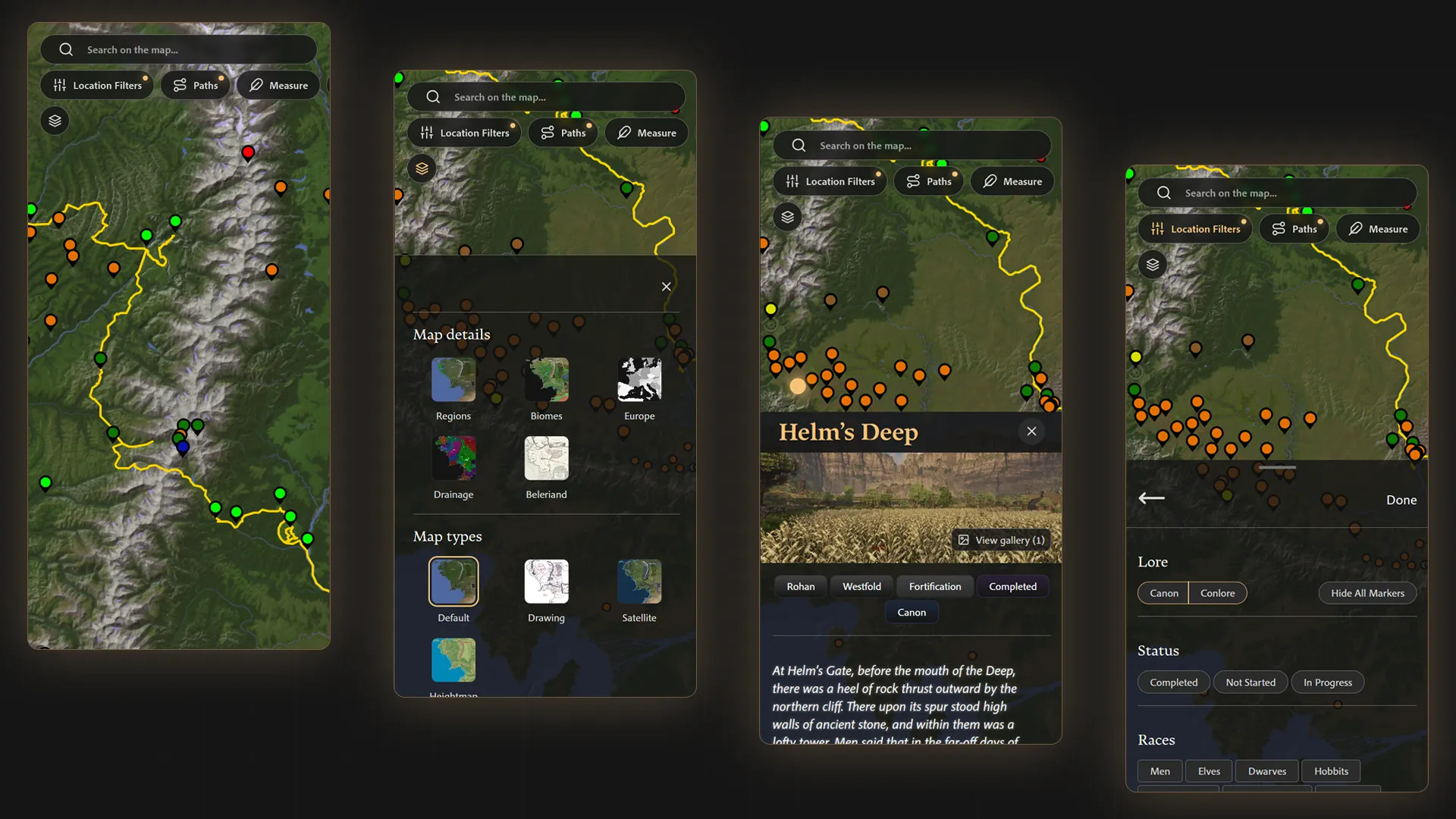
The global redesign of our website was the perfect opportunity to completely rebuild the map page and launch V2. I took the chance to refine the UI and fix several ergonomic frictions I had clearly identified thanks to Microsoft Clarity data. To test user engagement and explore new retention avenues, I also added a gamification layer in the form of mini-games.
One of V2's biggest challenges was mobile. Often, the easy way out is to cut half the features on smartphones. Here, all the major features were kept on mobile; only two games and a few very secondary informational elements were left aside, at the margins, to preserve the fluidity of touch navigation.
The numbers
Launching such a heavy tool on a community project involves constant trade-offs. Our Google Search Console data perfectly sums up this adventure, punctuated by launches and server constraints:
| Month | Clicks | Impressions | Product context |
|---|---|---|---|
| December 2025 | 1,500 | 108,000 | Official V1 launch |
| January 2026 | 2,710 | 196,000 | Paused mid-month (to avoid overspend) |
| February 2026 | 4,640 | 179,000 | Full month online, traffic peak |
| March 2026 | 1,550 | 97,100 | Paused mid-month (to avoid overspend) |
| April 2026 | 2,220 | 213,000 | Impressions stabilizing |
| May 2026 | 1,850 | 179,000 | Technical transition |
| June 2026 | 1,360 | 175,000 | V2 launch on the new site |
These figures are full of lessons. The potential is immense, we brush against 200,000 monthly impressions very quickly, but having to take the site down mid-month in January and March, to protect our budget, likely cost us dearly in rankings. Google doesn't like instability, and these interruptions slowed our growth momentum.
The Proof Through "Non-Brand" Traffic
Despite these technical disruptions, the strategic impact is undeniable. Since February, Google Search Console makes it easy to isolate "non-branded" queries (searches that don't contain the ArdaCraft name). The verdict is clear: the map alone accounts for 50% of our non-brand traffic.
It's the definitive proof of this strategic choice: we managed to capture an audience of pure newcomers and Tolkien enthusiasts who knew nothing of our existence before searching for a map on Google.
Goal V3
The good news is that migrating to our new decentralized architecture (WordPress, GraphQL, Cloudflare, Webstudio) finally gives us a reliable, scalable and financially viable system. No more sword of Damocles of costs tied to traffic volume.
The next step is therefore set: V3 of the interactive map. For me, this will be the final, complete version of the tool. The work will consist of fixing the last remaining bugs, refining the quality of our coordinates and polishing display details.
Today the technical foundation is robust and the content complete. Once V3 is deployed, our efforts will shift to the last essential pillar of our acquisition strategy: link building. We'll focus on a large communication campaign built entirely around the unique value of this tool, to earn the backlinks needed to durably establish ArdaCraft on those queries.